Monday, November 12, 2012

Day 2: Tallinn, Estonia

Tom and I woke up and went for a walk around the city.  We took a free walking tour of Tallinn that showed us most of the big sites in the city including my first Russian Orthodox Church.

Around 1900 the Russian Empire was nervous about talk of Estonia separating from the Empire.  In order to symbolically place their hold over the country they built the Russian Orthodox Cathedral on Toompea Hill, directly across the street from the seat of government.  Toompea Hill is the traditional place from which Estonia was ruled, and making a Russian religious building the centre-piece of the hill had obvious, political connotations.  This is still a bit of a sore spot for Estonians, as the cathedral is on the highest point in the city and can be seen from all around, making it, essentially, a permanent symbol of the Russian subjugation of the Estonian people, even after just over two decades of autonomous rule.  Tom and I went in the cathedral and he said it is a relatively plain church, as Russian Orthodox churches go.  

Religion in Estonia has been a little strange.  The Reformation reached the country in the 16th century and by the 1920s 80% of the country was Lutheran.  Then came the Soviet occupation and state-mandated atheism.  For some reason this atheism took hold in Estonia more than in any other part of the Soviet union.  To this day, only 20% of Estonians claim religious affiliation.  Of those most are Lutheran, followed by Russian Orthodox and then Catholic (the Catholic cathedral I visited had a sign advertising mass in Polish, Russian, English and then Estonian; Catholicism may be a religion of non-Estonians more than of Estonians.


This pink building below is the Parliament building; it is built on a site which goes back to the middle ages (and a medieval castle can be seen on the other side).


Tom and I over looking the city. 
All buildings in Old Town have to have red-tile roofs and either natural stone or one of three shades of yellow, a colour palette traditional in Estonia.

This is the outdoor stage, part of the Tallinn City Theatre.  I joked that the puddle was left over from  a production of  Metamorphosis, and then twenty minutes later I saw a poster for the show (turns out I was correct!).

St Olav's Church.  For part of the 16th and 17th centuries the spire here was the tallest building in the world.  The problem was that such a large spire was a natural lightning rod, and the building was struck by lightning and burned down twice.  The current spire is not as high as the previous one.  Also, the original is said to have been built by a man who sold his soul to the devil. 

On Tallinn's Town Hall Square there is a Town Hall building that is (I believe) the oldest, continually operating Town Hall in Europe.  The building is beautiful and is topped by a spire with this little guy.  his name is Brave Thomas (Voorna Toomas).  In medieval Tallinn there was an annual archery contest that only the nobles could enter.  The object was to shoot a wooden bird off a post.  One year no nobles were able to do this; a non-noble boy, Thomas, stepped forward and shot the parrot.  Instead of being punished of breaking the rules, he was given a job as a sentry on the town walls.  Thomas grew up to be a great soldier, and in his old age was known to be nice to children, always giving them candy.  After his death people noticed that the statue on the spire looked like Thomas, especially his moustache.  Parents started telling their children to behave, as Thomas could still see them from high up on the tower.  


Under one side of the Town Hall is this bar.  It is set in the medieval vaults of the Town Hall and has a medieval theme.  The two small rooms are lit only with candles and they sell mulled wine, meat pies, beer and soup (all very cheap and very good).  We spent many hours there, drinking wine and playing cards (more pictures of that later on).

Bears drinking!  Just a sign from a bar that I liked.
This is a medieval themed restaurant that I wanted to go to, but was very expensive.  
Tallinn even has Hare Kishnas.  They walked through the town everyday we were there , starting about 4pm.  
Tom and I love Indian food!  Since he has been in Russia he has craved Indian food, spicy food and any food that is not bland (which seems to be the national flavour of Russia, according to Tom).  Tom went to a restaurant a few weeks ago and was really excited to see that the menu included something that was supposed to be spicy.  He asked the waitress if it was actually spicy, and she said it was really quite spicy.  She lied.  For a few weeks before meeting in Tallinn, Tom researched Indian restaurants and found a great one, called Chakra.  It was fantastic!!!!

Day 1: Tallinn, Estonia


Tom is conducting field research in St Petersburg, Russia for two months.  We decided to meet for a holiday in Tallinn, the capital of Estonia (it is only a seven hour train ride from St Petersburg).  In addition to visiting Tallinn and Tom, I spent the night before I flew out with Jesse and Andrew in their new flat in London.  As a thank you I bought them a selection of cheeses from work, the remains of which can be seen on the table in the picture.


I arrive in Tallinn about 8 hours before Tom's train, giving me plenty of time to look around the Old Town, which is really small.  Tallinn is the largest city in Estonia and only has 300,000 people (the total population is 1.3 million).  Tom didn't arrive until late at night, so after he got in we went to a bar called Hell Hunt (Hell Hound) and then went to bed.  Not an extremely exciting day, but still good.  By the way, walking to the Tallinn Train station at night is kind of scary; ok, I tell a lie, very scary, especially if you go down the wrong road (like I did).

Before I go on to the next few days, I figure some history is in order (you knew it was coming at some point).   The following is an excerpt form a side bar in the free guide book I got at the TI called City Break Tallinn (pg 5).

8,000 - 3,000 BC: Finno-Ugric ancestors of the Estonians migrate to Baltic coast.

11th-12th centuries AD: Estonian clans use what is now the Tallinn area as marketplace and harbour; maintain wooden fortress on Toompea hill.

1154: Tallinn first mentioned in history records by Arab cartographer Al-Idris.

1219: Danish forces capture Tallinn.

1227-1238: German merchant families from Gotland settle at the base of Toompea, sewing the seeds of Tallinn as a German trading town.

13th-15th centuries: City sees massive growth as trading point between East and West.  In 1248, Tallinn adopts Lubeck Law, giving it self-governing status.  In 1284 it joins the Hanseatic League.

1346: Danes sell their Estonian holdings to the Linovian Order.

1558-1583: During the Linovian War, Tallinn was attacked and besieged by the forces of Ivan the Terrible.  Estonia ends up under Swedish rule [in exchange for help fending off Ivan, the Estonians subjected themselves to Swedish rule]

1710: Great Northern War (1700-1721) leaves Estonia under Russian Empire.  Tsar Peter the Great sets up summer estate in Kadriorg.

1860-1880: National Awakening gives Estonians a newfound sense of cultural identity.

1918: With World War I waging, Estonia declares independence on February 24.

1920-1930s: Independent Estonia established itself on world stage.

1940-1944: Red Army forces occupy and annex Estonia into the U.S.S.R.  Mass arrests deportations follow.  Nazi invasion in 1941 brings its own occupation and holocaust.  U.S.S.R. reinvades in 1944, tens of thousands flee to Sweden by ship.

1945-1991: Soviet occupation.  Estonia is cut off from the West.

1987-1988: The "Singing Revolution" - large-scale protest against Moscow rule in the form of traditional mass singing events.

1991: Estonia declares independence on August 20.

1990s: Economic transformation accompanied by widespread development of IT infrastructure.  In 1997, Tallinn is entered on UNESCO's World Heritage List.

2004: Estonia joins the European Union and NATO.

2011: The country becomes 17th member of the Eurozone.  Tallinn takes on its role as European Capital of Culture.


Wednesday, October 10, 2012

My day in Bristol

Tom and I spent a day in Bristol, a city in the southwest, near the southern end of the Welsh border.  Bristol was always a different kind of city; it was regularly in conflict with the crown, had the first professional playhouse outside of London (used almost exclusively for touring companies) and is in the process of introducing its own money (in the hope to keep money made in the city in Bristol, since it can't be spent outside the city).

Banksy is a famous artist who is based in Bristol.  I don't know much about him, but apparently it is not well known who he actually is.  I heard he is designing some of the new Bristol bank notes.

The first Banksy we saw in Bristol.

When we were looking for a place to have lunch, Tom jokingly said "Want to see how good their Mexican food is?" while pointing at a Mission Burrito.  I LOVE MISSION BURRITO!  I introduced Tom to Jarritos. 

Our second Banksy, called THE WELL HUNG MAN.  It shows a man hanging out the window of a flat while his girlfriend's husband looks out suspiciously.  You can see the paint ball marks from someone who didn't seem to like the piece.  This is on the side of a sexual health clinic.

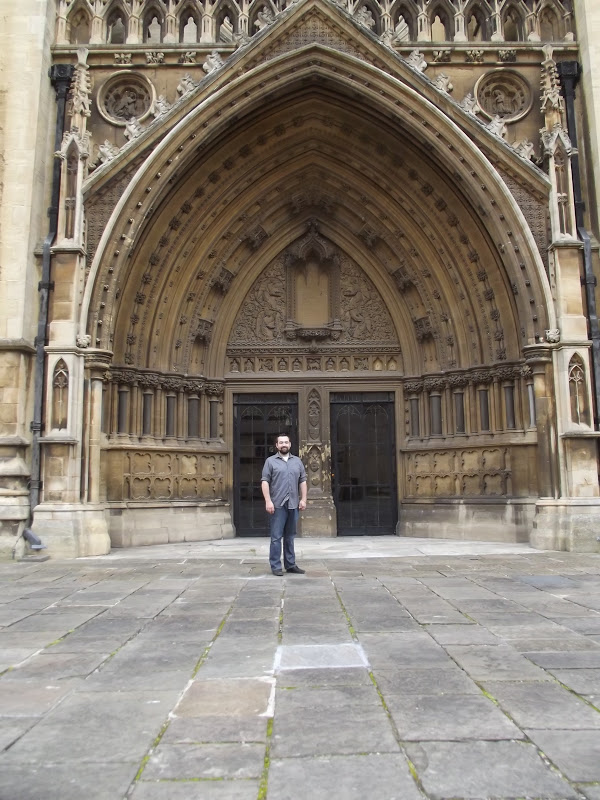
Bristol Cathedral!!!

AGAIN!!!

The Norman style, square chapter house in the cathedral.

Not a great shot of the chapter house, but still beautiful

Self explanatory.  

Me in front of the former consulate.  

Tom with his manly beard. 

It was a great day out.

Wednesday, October 3, 2012

My Trip to the Highlands and the Islands (30 September to 4 October)

Tom is leaving for Russia for a few months in about a week, so he decided to go visit his best friend, Fee, and her boyfriend Keith, who live in Oban, Scotland.  I tagged along (well, ok, I was invited).  

Welcome to Scotland!
Tom went to the University of Glasgow, where he lived for five years.  He really wanted to see it again, so we made a quick stop to look around and have lunch.

Being given birth to at the University of  Glasgow.

Tea at a very hipster (but stll very cool) tea house near the university.

The university.  So much nicer than Birmingham.
Just outside of Glasgow is Loch Lomond.  It is pretty.

Loch Lomond, outside Glasgow.

Loch Lomond.

When Jamie and I came to Scotland in July we saw this stop, but not in time to take a picture.  This time I was prepared.

Tom doing the dishes in Fee's house.  By the way, her house is so cheap (as in a very good rent)!!!!

Fee and Keith said that last year in Oban is rained all but two days.  Given this information, I find the omnipresence of outdoor washing-lines to be wildly optimistic

SURPRISE!!!

The harbour at Oban.

The buildings for the Oban Times.  A very small paper for a very small town.  

I didn't realise how much I missed the feeling of seaweed covering my feet.  

McCaig's Tower, a Victorian folly above the town.

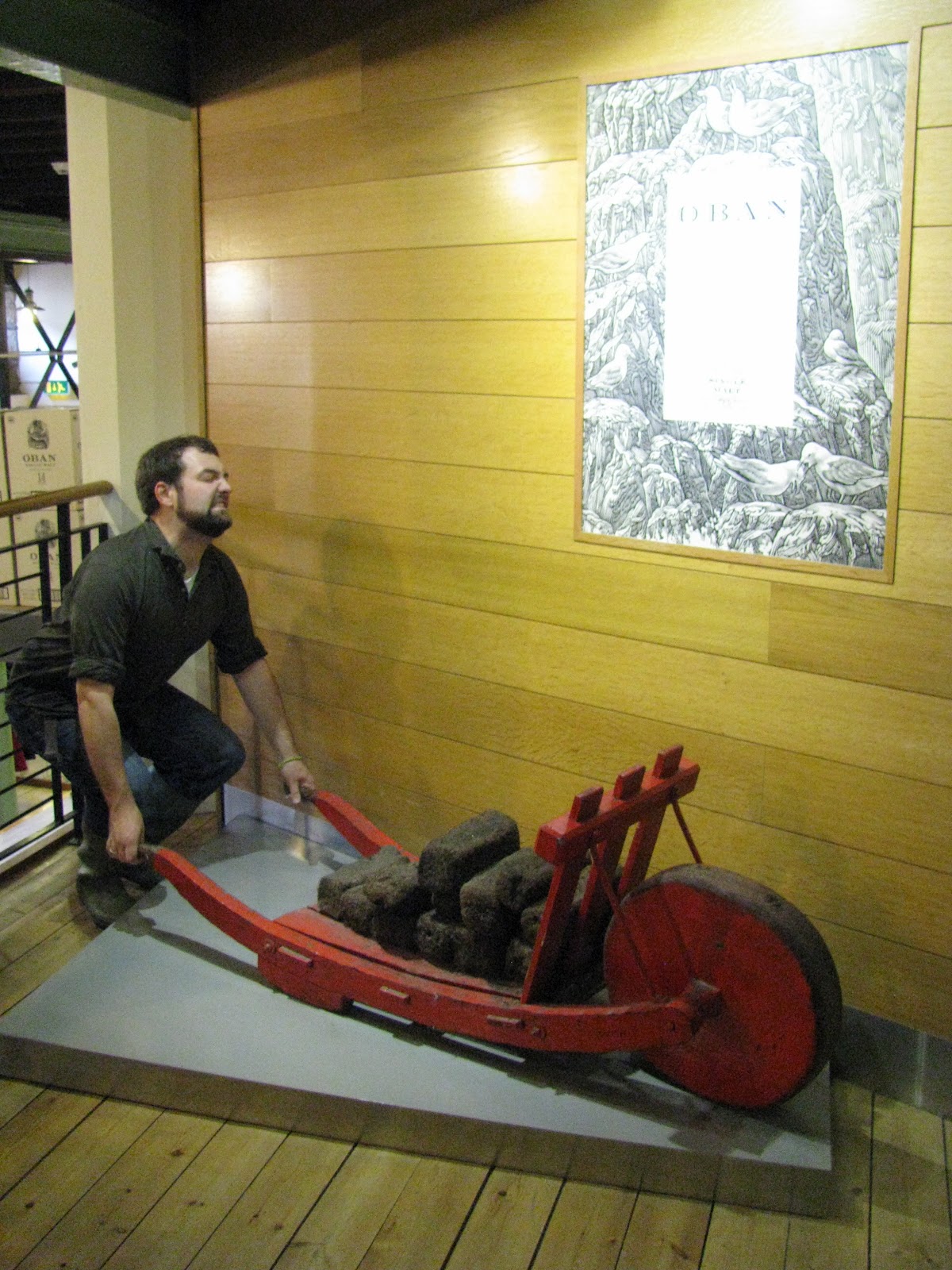
The Oban Distillery. Tom and I took the tour, which turned out to be the second best alcohol based tour I have ever taken (after Bacardi). 

The ferry ride to the Isle of Mull included some fantastic scenery and remote houses.  

This is why it is a bad idea to face into the wind and take a picture. Not only does your hair look, um, different, but in order not to blink you have to open your eyes REALLY wide.
Light house!!!! This is for you, Grandma Wissie.

And another!!!

Duart Caste on Mull.

The town of Tobermorey, on the Isle of Mull.  The steam coming from this stream was heated by the distillery of Tobermorey Whisky, where it is used to cool the mash before yeast is added.  

The town of Tobermorey.

Tom and I in Tobermorey.

Tobermorey Bay.

What a strange combo-shop!

This is a first.  An actual tap on the bar for adding water to your whisky.

Tom was a bit excited.  He REALLY enjoys whisky.

The Ferry.

Oban 14 is possibly my favourite whisky.

PRETTY!!!

PRETTY + Tom and I.

Scotland uses the same money as the rest of the UK, but they have their own notes. 

Loch Linnhe.

Tom, Keith and Fee at Loch Linnhe.  

Conclusion:  FANTASTIC TRIP!!!!